KYOTO CHATTERINGS

Nirvana, Zen - call it by any name. No words, no expression can ever attempt to capture even a fraction of what it is like to see a creation so stunning. The large gently rippling Kyokochi or mirror pond with tiny islands of rocks and pines, framed against verdant rising hills in the background, and rising from it a temple so unimaginably beautiful that it takes away your breath. Pure gold. Literally!The Kinkakuji (Golden Pavilion) or officially Rokuonji Temple in northern Kyoto is a gold-leaf coated structure that is in one word, spectacular in every sense.
There's a light drizzle and chill in the air, hundreds of thronging tourists, selfies and camera clicks, but you hear nothing and everything else fades into oblivion. The reflection of the temple in the pond further accentuates the dreamlike effect. You have seen it in pictures, in brochures as Kyoto's most known temple but to actually stand before it and take it all in is something else. The chimera factor - it is there right in front but you cannot access it, so close yet so elusive deepens the mystical element.
Built in the traditional Japanese temple architecture style, Kinkakuji has three floors. The large glass windows of the ground floor provides glimpses of the Buddhist relics housed there including a large Buddha statue. The second and top floors with curving roofs with narrow verandah are coated in gold leaf with all doors and windows shut. The structure was built as a retirement house for a Shogun in the 14th century and converted into a Zen temple after his death as per his will. Many memorable Japanese architectural works seem to have a nasty run-in with fire and Kinkakuji was no exception either. During the Onin war, in the later half of the 15th century the temple was apparently burnt down. If that was not enough, a fanatic monk was said to have set it on fire in the 1950s. Thankfully, it was rebuilt in 1955. Designated as a National Special Historic site and a National Special Landscape, the temple is surrounded by a large garden complete with a Tea house.


Across the main road on the other side lies Nara Park, where the deer roam free. I knew that I was going to see deer all over, how and all that was not something I sweated about. Bambi gets into your head and you imagine delicate large-eyed fawn beauties gazing at you with liquid melting eyes. We didn't have to get to Nara Park, just as we stepped out the Kankakuji temple, waiting to cross the road to the Park on the other side, a small-ish deer casually sauntered across the road, traffic rules be damned! She or he walked so freely as if to say what's-wrong-haven't-you-seen-a-deer-cross-a-road ever? That was cute. But the cuteness factor began to dull a bit when we got to the other side and groups of deer of every size-small, medium and large - ambled all over the place, going up to or following tourists, peeping into souvenir shops or simply squatting wherever they pleased. The sudden burst of heavy rains had everyone scampering around but the deer.
If there are deer roaming freely then there has to be some divine reason! Japanese folklore has it that one of the gods of a shrine rode a white deer and hence the unique status of divine deer. Today they are no longer officially divine but are designated national treasures. And the reason why the national treasures seem to dog humans/tourists is because they are addicted to rice crackers. I saw someone buy a packet and feed the deer. In a me-too mode I also got a packet and nearly got swamped.


Adjacent to Nara Park is the centuries old Todaiji temple (Great Eastern Temple) built then as the head temple of all Buddhists temples in the country. Till today its main hall, the Baibutsuden (Big Buddha hall) is the world's largest wooden building and contains one the largest bronze statue of Buddha(15metres tall). And yes, the deer are here too.


We walk further and suddenly something so familiar looks back at you. Thousands of miles away from home a replica of the Ashoka Pillar stands tall. A plaque nearby explains it all. In brief, it was built to commemorate 'The Thousand Priests Service' on Lord Buddha's birthday in 1988. A time capsule containing the names of the participants and the message for future written by the followers is buried under the monument. The capsule will be opened in 2038, the 1500th anniversary of introduction of Buddhism in Japan.


Kyoto in one sentence is a city of temples and shrines. Apparently there are over 1500 of them! For once we agreed that only the must see must be visited and Fushimi Inari Shrine was one. It was not only the closest from our hotel (second station from Kyoto on the JR Nara Line) but am imposing structure visible from quite a distance with its towering height and above all, predominant red colour, which to me veered more towards orange. Perched on a hillock at the base of Mount Inari,(from the shrine one can walk/trek up to the peak of Mount Inari that rises up behind it about 4 kms or so), the more than 1,300 years old shrine is dedicated to Inari God who is said to assure good crops. It is also the headquarters of all Inari shrines in Japan. The entrance itself is arresting with its two large sparkling red Torii gates and white foxes, the symbols of the shrine. There are statues of fox everywhere because it is considered a messenger of Inari. After you enter the second gate or Torii, there is the purification corner, basin filled with water.
But what is unique at Fushimi Inari Shrine is the endless row of Torii gates (Senbon Torii). These are basically Torii gates placed one after after forming a winding corridor that never seems to end. At places they are so closely placed that no natural light gets in. The custom, records say, started in the Edo period (1603-1868) when worshippers started dedicating a Torii gate to the shrine for wishes that came true or for wishes to come true. Guess, something like our 'mannat'. At present count there are said to be several thousands gates and the dedication practise still continues. With the throng of people, we preferred to turn back after a while and instead take the road to the mountain peak to step aside at the crossroad or view point, which gives a panoramic view of kyoto spread out below. Be warned: the Fushimi Shrine complex is enormous and if you want to take it all in, give yourself almost a whole day.


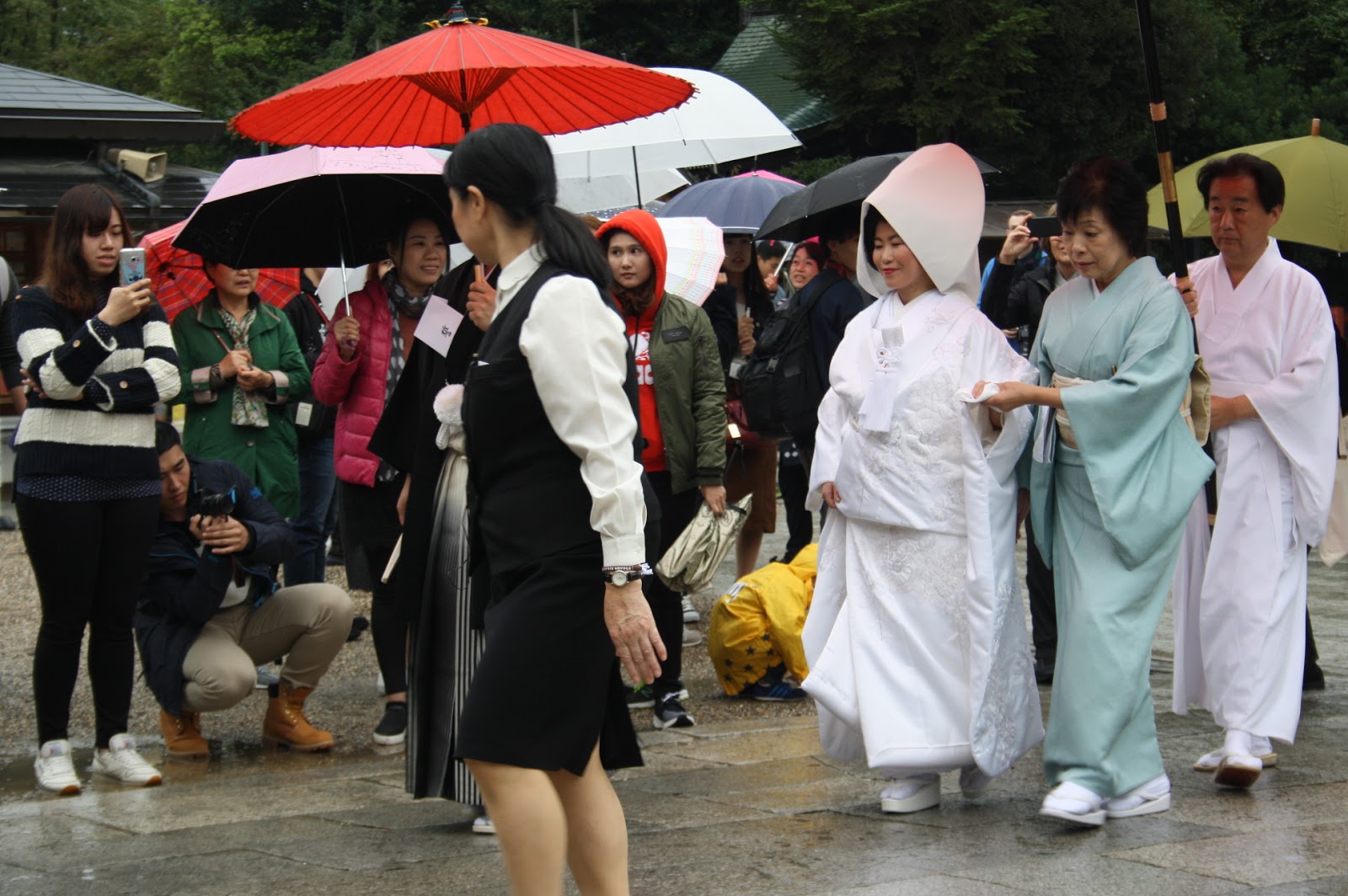
Then a beautiful thing happened. We were in one of the oldest Shinto shrine, designated by UNESCO as a World heritage site, the Shimogamo Shrine and a traditional Japanese wedding was unfolding. The bride in complete white wedding attire including the headgear was coming down the stairs in a procession led by two young women in orange kimonos and white jackets holding bright red umbrellas, with the bride under another umbrella followed by an elderly man in white, I suppose her father or guardian and men and women in two neat lines, all wearing black Japanese jackets. The procession winded its way to a roofed large hall without walls where the ceremony proceeded. There was something so sacred about it all.



Growing up in a hill station, right behind the back wall was this huge clump of bamboo that during the day was quite inconspicuous but as the hours darkened and the shadows lengthened, often acquired ominous proportions. Especially when there was strong wind around and the swaying bamboos produced an eerie rustling. It did not help that as per old Hindu traditions the dead were carried on bamboo bier to the cemetery. Okay I'm stretching it too far. A Bamboo is after all a bamboo. So its to the Arashiyama Bamboo Forest in Kyoto, sometimes considered one of the top must-see global list. They are tall, extremely tall like reaching up the heavens and standing sentinels on either side of a meandering path filled with tourists. What initially set me a little aback was, as if making a weird connection, the graveyard a little before the entry point to the bamboo grove.


Close to the Bamboo Grove is the Tenryu-ji temple, ranked first of the five great Zen temples of Kyoto. But if you ask me what I remember of the temple built in 1339, I will really have to work on my recall faculty because all I see is just its garden, the Sogenchi-teien or Tenryu-ji Garden. Said to be one of the oldest gardens in Japan, it was, as per records, planned and laid by the first head priest Muso Soseki in the 14th century and is said to retain its original appearance. It's the first Special Historical Scenic area designated by the Japanese government and is a coming together of Zen culture and ancient aristocratic Japanese traditions. The four seasons is said to be on its best display here.
If I were to look back on my Japan trip, the first image that takes over the is the view from across the Sogenchi Pond. Analyse it critically and its nothing- just a body of water almost encircled by various trees on undulating grounds. That sounds so prosaic till you see the colour palette. It's every tint of green, reds, russets, titian, a burst of orange, a touch of pale yellow, everything riveting. If that is not sufficient, the gently ripply waters has colourful carps with bright tints weaving in and out. It's an inimitable work of art, alive and breathing before you. So serene and calming like the ultimate meditation. Exquisite.


After
the ancient shrines, the exquisite gardens, the pulsating night life, the harmonious sync of the very old and the so ultra contemporary, the Kaiseki fare and more, Kyoto, the capital of Imperialistic
Japan (home to Geisha) still remains a little elusive and quite undecipherable, at least to me. Not that I have been able to deconstruct every city I have been lucky enough to visit.
Looking on the journeys one has made, there are somethings you distinctly associate with a place. Some are those you want to keep going back to, some are hmm and some are I-wouldn't-go-back even if you gave me all the treasures in the world. Then there are those images and memories that immediate unfold in our inner vision in full panoramic style, music et al in the background at the very mention of the place. Most make you smile and you let out a long sigh, not a sad one, but a very happy one. And a smile crawls across your face in full strength. You feel fortunate to have had that experience.
Looking on the journeys one has made, there are somethings you distinctly associate with a place. Some are those you want to keep going back to, some are hmm and some are I-wouldn't-go-back even if you gave me all the treasures in the world. Then there are those images and memories that immediate unfold in our inner vision in full panoramic style, music et al in the background at the very mention of the place. Most make you smile and you let out a long sigh, not a sad one, but a very happy one. And a smile crawls across your face in full strength. You feel fortunate to have had that experience.
Then there the people, the interactions, both good and not so good. Then there are pleasant surprises and untoward incidents. Its a collage of scenes and sights, people; a tapestry of these-are-some-of my-favourite things for every place!
Kyoto undid the norm. For me.
The first was at some train station. We all know that the Japanese are sticklers for punctuality and all that. We had barely a couple or so minutes to wait to make the next connection. The station was not too crowded and suddenly I saw this little school kid, three ID cards dangling around his neck, uniform, satchel etc all by himself. So I looked around for his mom/dad/guardian etc. He was blissfully skidding along as if on skates; next he made a dash for the rather small escalator, perched himself sideways on the side panel and swooshed down. From where we came, little school kids don't usually move around alone in a train station. As the train neared, the little boy stood in line. We boarded and so did he. And so did a number of little school kids, same uniform, three ID cards dangling etc. They were all travelling solo or in groups of two or threes. In a big metro little school kids travelling alone? Kyoto take a bow.
Technically Pontocho is just an alley but in reality this is where you go or have to go for a taste of its legendary nightlife. It stretches maybe a kilometre or so west of Kamogawa River. It is packed and stacked with eateries and bars and Tea houses of every kind. The atmosphere is so infectious that before you know it, you are caught up in it.There are youngsters, there are oldies (more the tourist kind), there those dressed as if they gave a damn, those dressed to kill and just about every kind. Get the drift - it's one enormous party and everyone is welcome. And it continues late into the night, especially on weekends. We are there on a weekend and and get into the spirit and more 'spirit' of it all. Somewhere a closed door gets my attention. Somehow it doesn't fit in, it look sedate and a little officious. Get closer and find its a police station or a police post or whatever. A sign says its closed! Two young hipster see me peering sceptically at the sign; they want to know if anything is wrong. Why is the police station closed when there is so much of revelry going on. But why do you need the police station they ask repeatedly. Because........how do you condense your conditioning, the circumstances and instances back home in a sentence?
I give a thumbs up sign and move on. Kyoto does that to you.


The first was at some train station. We all know that the Japanese are sticklers for punctuality and all that. We had barely a couple or so minutes to wait to make the next connection. The station was not too crowded and suddenly I saw this little school kid, three ID cards dangling around his neck, uniform, satchel etc all by himself. So I looked around for his mom/dad/guardian etc. He was blissfully skidding along as if on skates; next he made a dash for the rather small escalator, perched himself sideways on the side panel and swooshed down. From where we came, little school kids don't usually move around alone in a train station. As the train neared, the little boy stood in line. We boarded and so did he. And so did a number of little school kids, same uniform, three ID cards dangling etc. They were all travelling solo or in groups of two or threes. In a big metro little school kids travelling alone? Kyoto take a bow.
Technically Pontocho is just an alley but in reality this is where you go or have to go for a taste of its legendary nightlife. It stretches maybe a kilometre or so west of Kamogawa River. It is packed and stacked with eateries and bars and Tea houses of every kind. The atmosphere is so infectious that before you know it, you are caught up in it.There are youngsters, there are oldies (more the tourist kind), there those dressed as if they gave a damn, those dressed to kill and just about every kind. Get the drift - it's one enormous party and everyone is welcome. And it continues late into the night, especially on weekends. We are there on a weekend and and get into the spirit and more 'spirit' of it all. Somewhere a closed door gets my attention. Somehow it doesn't fit in, it look sedate and a little officious. Get closer and find its a police station or a police post or whatever. A sign says its closed! Two young hipster see me peering sceptically at the sign; they want to know if anything is wrong. Why is the police station closed when there is so much of revelry going on. But why do you need the police station they ask repeatedly. Because........how do you condense your conditioning, the circumstances and instances back home in a sentence?
I give a thumbs up sign and move on. Kyoto does that to you.


