Tuesday, 13 August 2019

ISLAND IN THE SUN


That's where all the Danes go to see rocks, said our friend's friends in Copenhagen.  Now it will be sunny, island in the sun, they said. So did a few others in the Danish capital. In my mind was this sunny island quite populated with rocks. That's an admission that my mental slate was totally virgin territory where Bornholm was concerned and, I had no clue what was in store apart from going by the partner's claim that it was one of the most beautiful place we would be going to. So, there was this blank frame with rocks  of every size randomly strewn around and the sun shining brightly. I was of course, more than sure that I would get lots of salmon to dine on.


The imagined rocky island turned out to be a little bit of paradise.  Only 227 square kilometre but Bornholm is a place that fits what we say,  'Uparwale ne bade fursat se banaye' (the one above made Bornholm at full leisure). The one above was more than generous in endowing the island with every possible awe inspiring natural beauty. Yes, there are rocks - stunning cliffs, miles and miles of almost white sand beaches, thick forests, rolling greens, blue waters merging into the horizon, bobbing boats, fishing villages, lighthouses, old traditional smokehouses, stretches and stretches of perfectly cultivated lands, mediavel fortress, cute cottages and above all, the play of light was unbelievable, amazing chiaroscuro. The best of nature in one small island in the sun, everywhere one looked was simply breathtaking.


It was an early morning start in a bus to Ystad (Sweden) from where the final leg would be by ferry. Sometime into the journey, the green fields and patches of forest transformed into endless mustard fields. It took me sometime to realise that what looked like bright yellow endless carpet was good old mustard. And of course it was inevitable that makki ki roti and sarson ka saag and 'tuje dekha toh jana..' song from Dilwale Dulhania Le Jayenge played in a continuous loop in the head! If that wasn't enough, Natasha, the chirpy mother of two, seated behind us said we were in Sweden. Mustard fields and Sweden? Guess one always needs to learn. To the loop was added two instant associations with Sweden for me - Stieg Larsson and his protagonist Lisbeth Salander, the girl with the dragon tattoo which is understandable but weirdly, a friend's sister married to a Swede husband and loves nothing better than Indian vegetable seeds to plant there particularly radish. 


The loop was arrested without brake when the bus stopped because all passports/ID needed to be checked by the Swedish authorities. Two cops- who looked young enough to  be college kids- got, one a blond man and the other, a young woman in hijab. Both looked so serious and stern, it made me wonder if projecting such an expression was part of their training. Meanwhile, Natasha, it is clear, loves to chat. She tells us she is working with the government while partner, seated next to her who never said a word but thankfully let a smile or two play around his lips, is still a student. Their older son is 9 years old. Marriage, she said, will  probably happen when they manage to pay off the student loans etc. Before long the Oresund Bridge is behind us and we are the Ystad  to board a high speed ferry (Bornholmslinjen) which takes an hour and 20 minutes. Incidentally, the Copenhagen-Bornholm lasts all of 35 minutes but I am glad we didn't take that.

 
The vehicles first board the ferry in an orderly manner, park, then the passengers alight and troop up. We follow Natasha and her partner's lead and are all seated and ready in the bus in perfect timing before the ferry docks  at Ronne and we are driven out. From the moment one drives into Bornholm, its charm is captivating.And above all, it is home to the rogeri or smokehouses which turn out the best of smoked fish especially herrings. The smoking of fish is said to have been introduced by Scottish sailors in the mid 19th century and gradually rogeri or smokehouses began to be set up all over the island. It is immediately identifiable with its tall open chimney/s - often one giant one, sometimes two, three or more - in a row with light smoke swirling up into the skies. The smokehouses function seasonally opening around April for six months or so. The smokehouses function as both shops and restaurants. We headed straight to Robiertia Rogeri at Svaneke with its five chimney stack in black and white, indoor and outdoor sitting, the lapping Baltic Sea right next door and two wonderful women, talkative and extremely helpful running the whole show.  Delicately scented with the aroma of the wood used, smoked for hours and falling off the fork, something one could savour again and again. And of course, besides the salmon and others, it had to be herring as the starter! 


The Rogeri experience set the way for our stay in Bornholm, travel around, take in and experience natural beauty and gluttony with a slight aberration. In keeping with our past tradition we just couldn't find the Dondalen falls, said to be highest in Bornholm! This time to  be honest we also gave up easily. We got down at the right spot on the road from Gudhjem to Tejn and started hiking into the wooded area, up and up we went, found a large meadow on the right and walked further and further and quite up into the forest which never seemed to be ending. The hike to the falls was said to be about 2 km   The hike to the falls was said to be about 2 km. All ears alert to hear the roar of falling water but no go. So we traced our steps back and started walking into the forest from another side, somehow there was the sense that it was the wrong route again. It was getting late in the day and it didn't seem a wise move to go further on. But water we did find, however little with a narrow plank like wooden bridge over it. Maybe if we had followed it upstream we could have found the waterfalls but then it remained a maybe.


And so we went off to medieval times and the largest castle ruins in Northern Europe! To the northern tip of Bornholm to Hammerhus, said to be built in the early 12th century, the ruins still stand  majestic on a 74-metre rocky plateau overlooking the Baltic Sea and assumed to be have been built by the Archbishop of Lund. The ruins are in quite good condition and the view towards the sea is magical. It's history comes replete with power tussle between the King and the church (till today it is clear that we never learn from history!) until about 15th century until the church finally gave in to the crown. It it is politics and religion, can treason be far behind? Nope. Apparently in the 17th century the Danish King Christian IV's daughter, Leonora Christina and her husband were imprisoned in the castle for treason. The couple tried to escape down the walls and cliffs but unfortunately failed. It was in 1740s that Hammerhus was given up as a stronghold and - wonder who signed the sanction - people of Bornholm could source building materials from the site. That continued for 79 years or so until wisdom prevailed and the Hammerhus ruins were put on the national historic register.


A big group of school kids, complete in colourful medieval gear engaged in spirited jousting supervised by a couple of adults. Appeared to be a history lesson exercise. When you manage to look away from the mesmerising views of the water and cliffs and come to the other side, an equally amazing sight meets the eyes. The visitor centre is literally wedged into the ruins facing side of a small rise with a flat field on top. Unless you look at it from the ruins, it is difficult to be seen otherwise. The long flat rectangular structure with large glass windows that provide panoramic view is quite a piece of architectural genuis.


Bornholm is small, so why not a ride around the whole island? We did that and I loved every bit of it, not just what lay outside but also how the transport system functions. The bus often drove for miles sand miles with just one passenger besides us. At best there would be not more than 8-10 commuters. Sometimes, it would be just us.


We were staying in Ronne, the entry point to Bornholm and as it always happens one checks out the neighbourhood mostly when you return back to where one is staying and that too when it is for required essentials or late night meals.  As we walked around one really late evening - its daylight for a long, long time-  and beyond what appeared to the main centre of Ronne, most of the eateries and shops had either closed down or was on the verge of doing so. Picture a beautiful setting, bright sunlight and yet, no people around, barely a soul here and there or the last of the diners seen framed in some restaurant. At one point it felt like a movie set, as if the locals and the regulars knew of impending doom and fled the scene and us, like two bumbling souls were all over the place. Thankfully, we found a Thai joint open and one couldn't have asked for a better deal than steaming hot dishes redolent with orient flavours. The pretty young manager was Sasithorn, married to a Dane and living in Bornholm for the last four years. The husband too is a chef and she said he was busy at work too but in some other place. The Thais, she said, were discovering Bornholm and there was even an association with over 1000 members. Needless to say that she ensured that our meal was more than good and better still, didn't rush us through. 

Perfect weather, blue skies, blue seas, silky smooth beaches, delectable food, impressive cliffs, forests and meadows, warm people - well if it is beginning to read like a travel brochure blame it on the Baltic beauty, Bornholm! Oh, don't forget the rocks. At the rate of sounding so shallow, I think going to see the rocks of Bornholm is the Danish version living it up, literally on the rocks!


Monday, 12 August 2019


  CHRIST- IANIA! ARE WE FREE?


Sometimes, often more than sometimes, the urge to step out of societal trappings and norms, say boohoo to rules and regulations, shirk off all responsibilities and diddly off to a place where none of these things matter, I am sure, afflicts us all. Unfortunately, for whatever reasons it is not always possible. But then there is always Christiania (Copenhagen, Denmark) the freedom town where one can, even for half a day, think yeah! I am here and relish the unimaginable even though it may be only vicariously.

Long ago a TV documentary had piqued my interest especially one of the residents, a silver grey haired elderly woman, rather elegant looking, who smashed my wrong perception that all Christiania residents were young hipsters with long unkempt hair, low slung jeans on the verge of slipping down any moment, basically rebels for the sake of being rebels. So, the very next day after landing in Copenhagen it was mission Christiania. What is it about this 19 acres of area, a self-declared sovereign since the 1970s, that is so appealing? Anarchy is a word that one usually doesn't get to use in everyday talk, but I like to believe that it is anarchy, in the sense of thumping a nose at all authorities and an attempt at creating a free society without a government and its stipulations. Not anarchy that translates in free-for-all and chaos.

From the entrance gate itself, Christiania, makes its status absolutely clear - you are now leaving behind EU and stepping into a free town. The gate is two tall totems with a wooden plank across bearing its name and when you leave, its not possible to miss what is written on the back of the plank: You are now entering  the EU.  That is some declaration of independence!

The delicious irony is that Christiania was apparently an abandoned former military base and in 1971 some hippies broke down the barricades and starting squatting and before one could say jumping jeepers, Christiania flourished. So does all the 900 odd residents of the self-declared sovereign do as they please? Nah! The community has its own rules and regulations! I guess we humans are genetically wired that way. The foremost rule is No Photographs without permission and absolutely No Photographs of Pusher Street or more poetically, The Green Light District where cannabis was sold. After the September 2016 shootout over cannabis trade that saw death and injuries, the community has been campaigning to stop all such trades. There are no stalls selling cannabis, however, on the morning we visit the number of  guys set up trays on stands displaying their wares. The area is also quiet thick with the smell of reefers. By afternoon their number has gone up. During the time we are in that area we see lots of curious visitors but nobody approaches the hawkers and nor do they solicit business. The other important rule, we are told, is No Running at all. Running creates panic and that's the last thing the residents want.

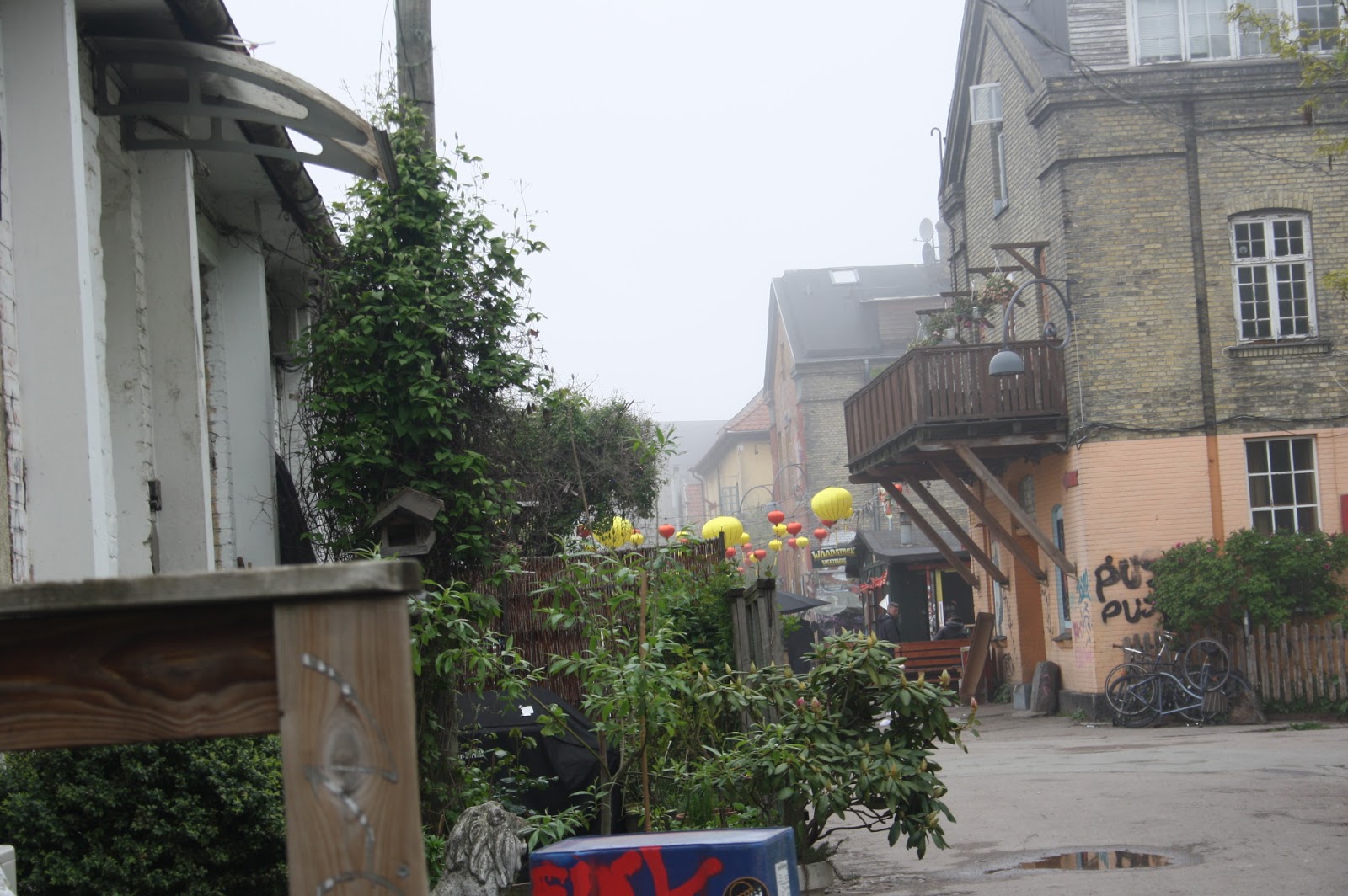
A tinge of Thamel (Kathmandu), a brush of some of Thai night markets, a wee feeling of some area of Goa but essentially everything wholly Christiania. The first impression, graffiti-ed walls or no, buntings or prayer flags - is just how clean the whole place is, everything in its place and it's like an invisible workforce around who seem to say that just because we don't believe in governments does not mean you can litter our world. There were the di rigueur houses that screamed 'me hippie' but there were those ones that could easily fit into the picket fence and two kids slot and some that seemed little tired and on the edge. Personally, it was an unexpected sense of calmness, all calm and clean. Maybe because we were there on a weekday, maybe it was the overhanging grey skies or simply maybe it could be indulging in what the nuns at schools always cautioned not to do- letting imagination fly away just because it happened to be Christiania. So, I didn't go checking patches of short greenery for what we call 'bhang'. Quite an appropriate name in fact, after all it creates a bang within you.


Yes, there were the expected stalls selling T-shirts by the dozens emblazoned with all kinds of messages in all shades of hue from neon to glittery; lots of jewellery most of which clearly winged its way from India, the kinds sold dime a dozen in Sarojini Market and Janpath in New Delhi; ditto with the stoles and shawls and some of the dresses and of course, plenty of smoking pipes. Then there are the eateries, quite an impressive variety- from organic to regular burgers, vegetarian to Thai, yummy desserts to different coffees. My favourite, the one with the big blue door that announced 'hot beer, lousy food, bad service' and cheerfully added 'welcome'. I don't know if that was just a joke or actually an eatery!
Then there is the Market, a huge, long rambling barn like structure with mezzanine floors and extra high ceiling which, for some reasons seemed to be selling almost everything related to gardening. No, I didn't mistake a nursery for a market because it loudly proclaimed that it was one. Sure, there were other stuff, but very few. Clearly, Chritiania has heavy duty gardening enthusiasts!

Another place that got me really curious was a bit of Nepal, a rather crude small copy of the famous Swayambhunath Temple in Kathmandu, complete with the third eye, Tibetan prayers flags, a blue hut like structure next to it, all in a small compound ringed by a cement and boulder wall.  I crossed that place twice and lingered around a bit, hoping someone would pop out or someone would cross the lane in front of it and someone who know something about it. Nada! not a soul. I gave up while giving into my imagination running away ipicturing a hippie who so loved Nepal that he/she attempted to create a tiny however version of it in Christiania or many the occupant was a Nepalese or Tibetan. Was I secretly yearning for momos? Maybe!  
Christiania is said to be a real music hotspot with plenty of live music with concerts, DJs, performances and the works.  I guess it was too early in the day to get a sense of it. 

The best statement about Christiania I guess came from the two fathers with one toddler each in their typical Danish cargo bikes, bare-chested hunks in just shorts peddling side by side carrying out conversations even as their kids behaved like all kids their age do -gibberish talks while reaching out their hands to touch each other. And since they couldn't do that, there would be another round of gibberish outburst interspersed with tiny laughter. In the end, I presume, hippie or prude, liberal or conservative, rebel or acquiescent, a father is a father. And nothing like a baby to level it all! I thought I'd sneak a silent shot from the back and scoot from there but there were others around and the No Photographs rule- sure I broke it at times but notice there are no humans around in them - went ping-ping in my head. That image will however be never forgotten.


Friday, 2 August 2019

DREAMING DESIGNS


A bridge is a bridge one might say, but certainly not The Butterfly Bridge. It is indeed at first glance just like any other bridge, a pedestrian bridge that connects Christiansshavns Kanal and Trangraven. Until, it opens up to let the boats pass. It doesn't open up just like that. The bridge has three prongs and two are movable and the last two open up and when they do, its like two wings of a giant butterfly, as if getting ready to take flight! Simply spectacular.

It could be a serendipitous coincidence but I had just been reading Pico Iyer's Autumn Light: Season of Fire and Farewells and it brought to mind Fukushima Roshi, the official Zen Master who confesses to five attachments even though Zen Masters are forbidden all attachments. The firsts, he says is Starbucks coffee lattes, the second chocolates and the third, a little bit spiritual idea in his own words: bridge. Yes, a bridge!

Unfortunately all my efforts at getting the picture of the bridge as it opened up gradually, spiritual or otherwise, went kaput. And whatever few does not do justice to the magnificence of it. So I am going with the pictures from the Internet with due acknowledgements


(www.designboom.com/architecture/dietmar-feichtinger-architectes-butterfly-bridge-copenhagen-04-20-2015/)


     (http://www.designcurial.com/news/pedestrian-bridge-design-copenhagen-4884854)

Dietmar Feichtinger Architects is the brain behind it. The firm won the competition to design the bridge, construction began in 2012 and three years later in 2015 it was opened. Just three years from planning to construction.  Its like the Danes and Design go together. Simple yet sleek and sophisticated, functional, simple and organic and so elegant. By now I guess design is wired into the Danish genes. They gave us the PH lamp and the Tivoli lamp (Poul Henningsen) and the ergonomic chair (Arne Jacobsen)  They know what  the core of design is and deliver it with quiet aplomb. No pshosha, just simple beauty that blows your brains away.  The 129 years Designmuseum Denmark does exactly what it claims to - 'to communicate the idea of quality within design.' It is here that the spirit of the 'grand old man of Danish furniture design', Kaare Klint, who furnished and designed the museum's inventory still resides. The collections ranges from furniture to silver, ceramics, fashion, textiles to digital design and according to the museum only a fraction of the collection is on display. Nature is clearly the inspiration for the creations. Sometimes, words fail miserably to communicate the stark but stunning beauty of some of the creative works. It happens within the museum, an almost day long visit is about experiencing. And about eye-openers, it definitely makes you look twice at each chair or piece of furniture you come across!  


Step outside, at the back of museum, and its a huge green courtyard with a cafe. Design communication especially chairs reawakened a strange correlation - the crashing of a chair on my head! But that's another story that's best left untold!


(In the picture the skiing slope is behind the smoking chimney!)

After the chairs, it was the stairs or precisely the cast iron staircase in the Hay House, the Danish design store that had me waxing eloquence.  The store on the second and third floor of an apartment in Copenhagen showcases the best of Danish designs for home. Laid out like an apartment, it  has everything a proud homeowner would covet. It's a wooden staircase that begins right at the centre of the living room on the second floor, goes up one flight and turns left for another to the third floor. What gives it the eye-catching factor is the balustrade or the railing. On the right hand side are evenly spaced out straight slim posts in red, with two smaller ones placed across, again evenly distanced, on each post that hold plexiglass squares in place. In sharp contrast on the left, instead of the posts are thick-ish tendrils that weave in and out gracefully. Hay house leaves one oohing and aahing and fervently wishing for a king's ransom to buy everything. 


Maybe its the always said pancake-flatness of the Danish capital that lets its architecture and buildings, a beautiful co-existence of old and modern to very modern, make such a statement. Strangely, the sleek modern structures bang next or at times abutting old historical buildings far from jarring create an interesting mosaic. Like the Royal Library more known as Black Diamond.  An extension of The Royal Library a historical brick structure, the waterfront very futuristic Black Diamond with its sleek almost mirror like black marble and dark glass exteriors can easily be believed to have one day heaved itself up from the depths of the waters. Quite close to Amager Bakke, is the Copenhagen Opera House, another architectural marvel. From the front, the building with unique roof almost appears to be gliding on the waters.  


There's another building which appears like two long rectangles joined by a row of square glass windows with two small triangle roofs. Sounds boring sure. What stops one in the tracks is the treatment of the walls, real trees with thin limbs and small leaves draped with a delicate lacy filigree. It certainly takes another level of creativity to think, plan and execute such an ingenious design.There is another building which has on its top what looks like a huge archway cutting through the middle and some construction work still going on. Look again - it's a clever but beautiful mural! Another brick building, a residential one, that could have been another faded brick most unimpressive rectangle with a triangular roof  but for the so simple yet so wondrous balconies.


Portable conical traffic dividers like stands, with bright orange square base and conical top, neatly lined up at equidistant posed some interesting questions with the simple option of a turnable circle on the top bearing just two options, a 'No' or a 'Yes'. The questions ranged from, 'Should the carbon footprints of an individual citizen be unknown to the government?' to 'The airspace in the cities should be free from airborne delivery drones?' to quirky ones like, 'People should be able to visit a shop and remain anonymous?' to ' People should be able to work without being tracked by sensors?' If I was associated in anyway with the Royal Danish Academy of Fine Arts (KADK) and had to go there regularly, every free moment would have found me pondering the right answers at the Academy's huge courtyard's unusual posers, probably a temporary show. Even then I would have loved to check out every single question and add my two bit, but we had just met a lovely couple, friends of friends, who were to take us around the school of Architecture. In brief, The Danes plan, design and construct to be part of nature with prevailing natural elements beautifully blending  and not standing out as ugly eyesores.
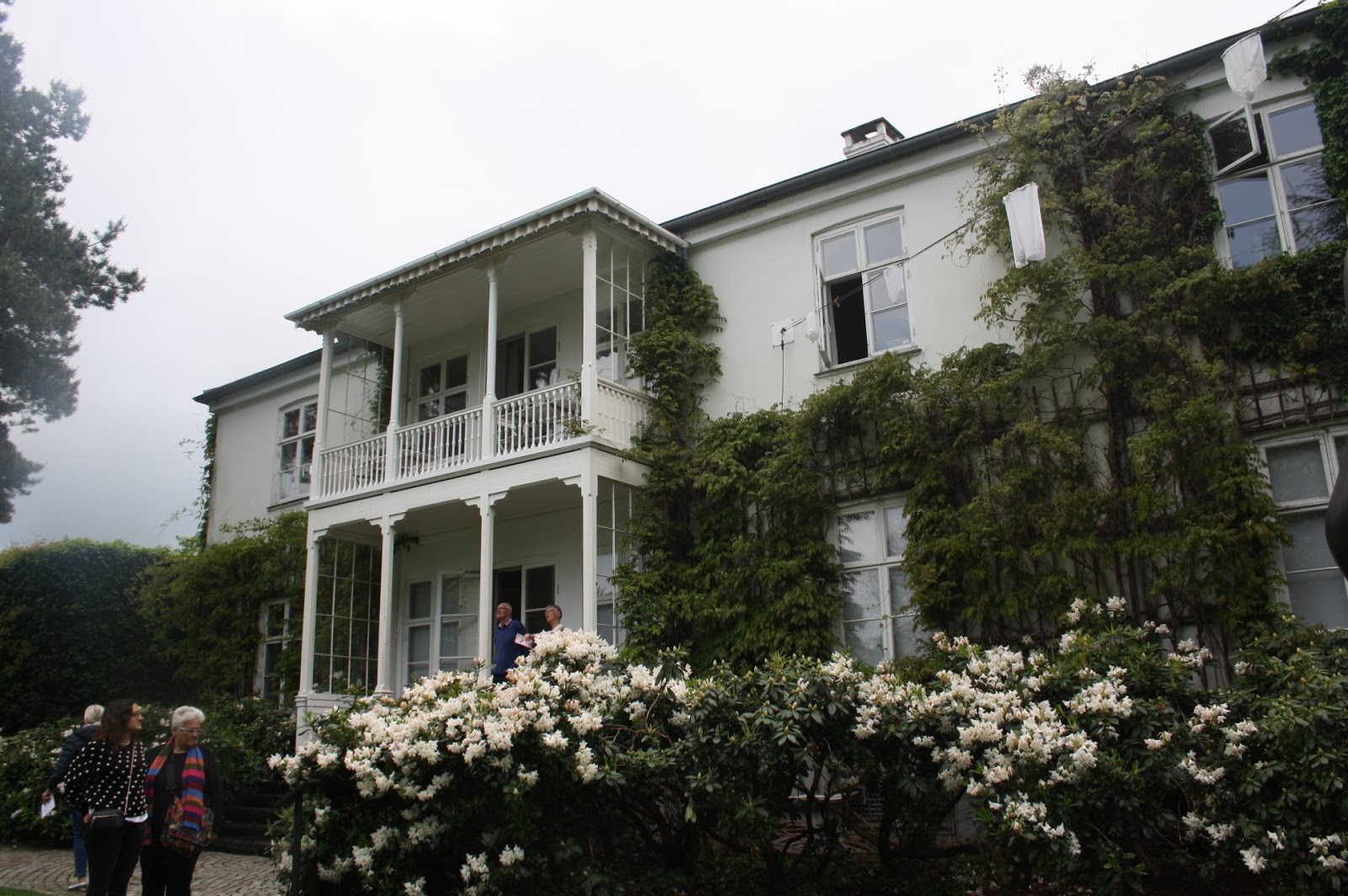
After that it was the The Louisiana Museum of Modern Art. Acknowledged as one of the leading international museum of modern art and founded in 1958, it is a stunning piece of art itself! And it unfolds in a spectacular way: Walk in through the main entrance to be greeted by Henry Moore's 'Reclining Figure' and the seemingly simple looking structure with ivy covered walls, take in the museum's different floors and then walk out towards the rolling greens through the back doors and wham! All the senses get arrested  because the sight that spreads out is beyond description. Beyond the undulating greens, dotted with sculptures, lies a virtual Zen painting, the blues of the endless waters merging into the blues of the skies, both tinged with an almost mystic touch of grey.  It makes one realise that no human artistic endeavour can even capture a wee fraction of natural beauty. The whole ambiance is almost surreal - the all white front facade of the villa like museum, a tree by itself among the greens with unusual hues and elegant form almost dwarfing the outdoor works of arts, the  mix of old and new exhibits, the cafe and the waters and Sweden beyond.  


But why the name Louisiana in Copenhagen? I could almost hear the American drawl. Louisiana because of three ladies, all named  Louise. The house was built by one Alexander Brun who was married thrice and each time to a woman called- what else- but Louise! And when the museum founder Knud W Jensen brought the property, he retained the original name. 
 
After nearly the whole day  at the museum, I would have been happy to be an inconsequential permanent outdoor fixture in that vast landscape forever but for the under wears! Modern art is modern art, take it or lump it but to have an exhibit that involved clotheslines strung all over with undies of every shape and style flapping above was in plain terms, or rather my term that is, not my kind of art however profound a statement it was meant to convey. It was almost like the serpent in the garden of Eden.  If that calls for being labelled a philistine, so be it. 


  Budding Lavender PICTURE-PERFECT PROVENCE Some love stories can happen unplanned and unexpected. In life, I suppose, one can fall headlong...