SEOUL-FUL STORIES
.jpg)

No, I have no clue whatsoever about K-Pop except of course, Gangnam Style which I keep mispronouncing as Gang-man!
No, I have not clue about K-Cosmetics
So why South Korea?
Because who says no to travelling?
Also because of curiosity as to why quite a large section of of people all over, especially the younger generation, were going gaga about K this and K that.
We arrive in Seoul and found we have been checked into a disable-friendly room. Totally lost about the why and what; walk into the room that is quite spacious, a big bathroom with an electronic door which said mechanically every time one pressed the 'open' and 'close' tabs what I presumed was something akin to 'door opening' and 'door closing. Maybe it was the late night flight but it took a little time to realise that the whole layout was wheelchair friendly! All great but god forbid if you had to use the loo in the middle of the night because the robotic female voice was enough to give anyone the creeps. From the second day we sensibly decided to leave the bathroom door open before retiring for the night.
With going out for Korean food and drinks back home a regularity, the immediate to-do task was to satiate hunger pangs. The South Korea capital is a food lover's heaven like nothing else. At almost arm's length we found we found several streets lined with eateries and cafes of every size and shape and menu. We did what we do when hunger bites, settle for the known and familiar and settled opted for Chinese food.
Names and street names initially appear flummoxing as if too many alphabets were mistakenly overtyped. Thankfully, the tour guide for our 'night walk' gave us her anglicised name which, one found later was the norm. We form a small group of different nationalities. It's a walk through the main road of Insadong that can be said to be the central part of Seoul, with alleys branching off, a mix of old and new with endless eateries, cafes, art galleries, antique shops, and packed with people.


The first stop - the Changdeokgung Palace, a UNESCO World Heritage listing since 1997 and described as an' outstanding example of far eastern palace architecture and garden design' because the buildings are 'integrated into and harmonized with the natural setting'. It is indeed in every which way.


The palace is said to be one of the five grand palaces built during the Joseon Dynasty rule beginning in the late 14th century. As always, when there are palaces there are stories of intrigues, too many tales both make-believe and actual, and destruction, fires, deception, lunacy and the whole shebang. No different here too! That however, in no way takes away from the fact that Changdeokgung Palace is beautiful with a calm inducing atmosphere. The entry gate is quite a marvel of perfect symmetry and precision structure. The patterns and colours somehow reminded one of Buddhist structure in Bhutan and Sikkim.
Live baby octopus. That's the surprise dish on the tour inclusive dinner menu. Baby? Alive? I don't know whether to scream blue murder or simply hot foot it out. But everyone in the group is all excited. The diner is at the food street of Gwangjang Market, said said to be one of the first permanent markets and our guide tells us one of the most popular tourists spots in the city. The market is basically a wholesale one and apart from the rows of hundreds of shops jostled together, street vendors with wares spread out leave little walking space.


The dinner is a traditional spread with clear beef soup, mung bean pancakes, kimchi pancake, Tteokbokki (yes, its the correct spelling!) - glutinous rice short cylindrical noodles in a reddish sauce - pork dishes, kimchis etc and of course the live baby octopus or San Nakji. What comes is a large plate lined with beef tartare with little greens on the side, some green chilli pieces, a glistening egg yolk and chopped octopus spread out all over with a sprinkling of sesame. The octopus pieces are clearly tentacles and yes, some pieces seem to be waving, more like wriggling. It took repeated reassurance from our guide for me to accept that the octopus is not really alive and that octopus die once their heads are chopped off and that, what we were witnessing was some pieces reacting to the salt and seasoning put on it. Lets say I survived.


Paying penance? Its Jogyesa, the Buddhist temple next. Ablaze with lights - incidentally, the Lantern Festival was on - the entire compound has a canopy of colourful strung lights. A small tableau near the entrance steps equally colourful and lit up had figures that to me honestly appeared a tad tacky. The main temple has a giant gleaming brass Buddha but unfortunately, we couldn't go in as a prayer s service was on with white and ochre robed monks filling the commodious hall . On the rear wall of the temple there are seven big panels with delicate artwork containing Buddhism imageries. To say it as it is, in a totally capitalist electrifying city like Seoul with skyscrapers, towers. glass and gloss, non-ending plastic surgery clinics and cosmetic stores everything fast paced and futuristic, the temple is like a secluded world of native beauty and innocence.


In contrast, the Dongdaemun Design Plaza (DDP) is more than futuristic. The Zaha Hadid designed building has huge exhibition halls, retail stores, some restored parts of Seoul fortress and a walkable part on its roof. It's steel, sleek, sinuous and something quite space-agey, something that maybe Neo from Matrix would be at home at


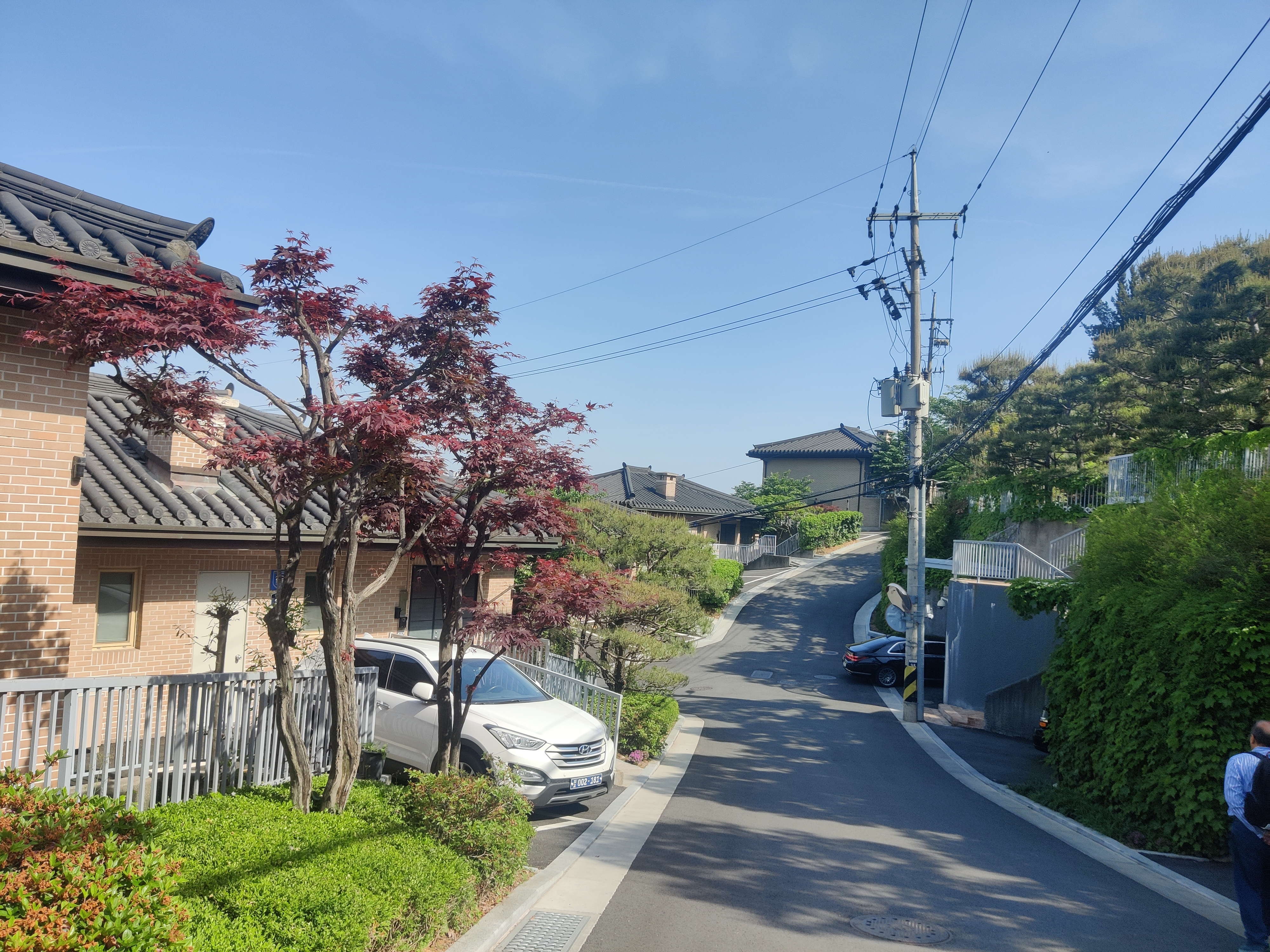
Seoul might be a very modern city but it is also interlaced with very traditional elements and the prime example is Bukchon Hanok village. It is an undulating area with all traditional houses called hanok. Bukchon translates into Northern village. There are many placards with a little yellow-hatted boy with a finger on his lips requesting one to 'keep your voices down'. Like hah! It also reminds one of Anafiotika the small neighbourhood on the slopes below the Acropolis in Athens which ask tourists to keep quiet too but in a rather direct manner.
Bukchon is a showpiece and parts of it houses cafes, tea houses, restaurants, art galleries, guest houses, stores and that inevitable ubiquity factor to such tourist attractions - hiring of traditional costumes to pose in. Not surprisingly vanity seems to be a feminine thing because one finds very few men traipsing around in the Korean costumes. Cynics might label Bukchon a perfect tourist trap but after a while its charms grow grows especially if one wanders off the tourist packed lanes and finds beautiful quiet lanes with very well maintained hanoks, big and small with verdant and flowers abloom lawns and gardens. The feeling is like stepping into another aesthetic and genteel world untainted by commercial tourism.


.jpg)

From placidity to unadulterated exuberance is an emotional swing alright but a very welcome one. It's strange that while K-Pop, K-Drama and even K-cosmetics seem to be gaining universal popularity, nothing is known about 'Nanta'. I plead guilty of being among the ignorant until the other half surprised me with the bookings for the show at the theatre in Myeong-dong for the comic musical which premiered in October 1997. How should one limit all applause, unmitigated delight and so much of laughter in a sentence or to?
A true blue burlesque, non-dialogue with a cast of just five characters including one female, set in a kitchen of a hotel. Nanta is a tour de force. Just how much? It has done worldwide tour of 58 countries, 318 cities, 47,087 performances and is still going all guns firing. One steps out of the theatre with a grin on the face and a lightness in the heart.


Another amazing discovery came in a little cute bottle! It was at one our early dinner- Korean barbeque and the works with of course, Makgeolli that one found Bokbunja-ju, a Korean wine from wild black raspberry. The rich colour, the fruity flavour is simply addictive.

From the new, the old and intoxicating discoveries it was time to take in the unavoidable ground realities. That to the north lies what else, but North Korea. An early morning drive to the De-militarised Zone (DMZ) with our guide 'Daniel' briefed us about Korean history- the 35 years of Japanese occupation, the Korean war, the division of the country etc. History is not always pleasant.
The drive is quite long passing small towns, villages, vast track of agricultural fields and greenery everywhere. Incidentally, it is essential to have your passport on you, not the xerox copies but the real McCoy which is checked twice by security forces. Korea is also one country where military service for a couple of years for youths coming of age is compulsory and most of those in uniform checking the passports seemed to be new cadets.
The first stop is at Imjingak Park (and resort). We are told that Imjingak was built in the early 70s with the hope that one day the two Koreas and millions of divided families would unite. Unfortunately, it hasn't till date. There are war related artefacts, memorial hall, a steam trains that was said to carry food grains and more. Then there is the Freedom Bridge, a misnomer if ever, standing so forlorn unlikely to feel human steps on it every again. This bridge was where prisoners of war was exchanged in 1953. And above all, there are two statues of the 'Comfort Women' representing thousands of women forced into sexual slavery by the Japanese. As in almost all eastern and oriental nations after the occupation ended, the society at large refused to welcome or even acknowledge the brutal fact. It was decades later that in 1991 a former comfort woman went public and only then the issue was acknowledged and raised . Right then what gets my goat is the eagerness displayed by some tourists and that too mostly women to click selfies or photographs with the statues.
The climb is short but quite steep warns Daniel as we make our way up a curving trail believe it or not lined with a thick hessian like material I guess to cut down falls. A sweat inducing but a very refreshing uphill walk later, the 150 metres suspension bridge- bright red, white and steel- appears. It is said to be the country's longest tower less suspension bridge. The walk across is easy and beyond the hills rise up gently eventually leading to a modest waterfall and then more altitude thick with forest. 'Modest' because when you grow up at the foothills of the Himalayas the neighbourhood waterfalls are more voluminous and thunderous!
The weather begins to look ominous and just my luck that when we finally reach the Dora Observatory what greets us is a thick and thicker curtain of clouds with zero visibility which means not even a peek at North Korea. No, there was no abnormally loud K-pop blasting with the speakers directed at North Korea either. Lots of prayers sent up but sigh. When the elements conspire against you, you accept the inevitability, tuck tail and walk away hoping that there will be another time. Hah!
North Korea has so far dug four tunnels clearly aimed at launching attacks on its southern neighbour. We trudge to the Third Tunnel, discovered in 1978, said to be 1.6 km long, 229 ft deep and broad enough to let 30,000 soldiers move across it. All visitors are warned about claustrophobia, kitted out with hard hats and repeatedly told to turn back at the first feeling of unease. There are railings to hold on at the sides, strategic lighting, wall mounted oxygen canisters at intervals et al. Unfortunately, its a no-photograph zone as well. The whole tunnel trip, one cant help feel is overhyped! At the risk of being labelled supercilious and show-off one has to say that compared to the Cu Chi tunnels dug up by the Viet Cong soldiers and the difficulty in traversing through it often on panic-mode, this one is like a walk in the park.


If a drone had to take pictures of Seoul while circling over it, what would be the view? Forget drones, just head for the Namsam Seoul Tower located on Namsam mountain, for a sweeping view of the city. This was one time when the super efficient transport system in Seoul defeated us. (The public transport system is exemplary with seamless coordination between the underground and surface transport and not knowing the language is no hindrance at all. One single card can be used on trains, metros and bus). Either we mucked up, missed a stop or whatever but there seemed to be no sign of the right numbered bus that would have taken us to the top. And oh! the bus stop bench had two frogs holding it in place. Even as we tried to check, recheck the bus schedules a young couple seemed to be on the same boat. From Copenhagen, she was of Syrian origin and he Moroccan. I loved her name in Arabic which sounded similar to a Hindi word and both translate into 'good beginning'.
Ultimately we decided to Uber it. From the base of the tower a short cable car takes one up and disgorges all from where one takes walk over a little wooden curved bridge like walkway to the ground level viewpoint before going up to the tower top. the walkway has its entire railings completely covered with the most colourful and paired locks bearing stick-on messages in Korean. I guess it wouldn't be a wrong assumption to say that it is a follow on of the Pont des Arts or Love Rock Bridge over River Seine in Paris where lovers put padlocks to mark their relationship. Unfortunately, one couldn't find when and how the custom began here, The tower(774 ft)is said to be second highest point in Seoul and the 360 degree view, as expected, presented Seoul as a well planned metropolis with the hills in the distant background and more than sufficient green coverage .


I had a couple of must-visit on my list and after a few civilised (ahem) 'your way, my way or the highway' we met halfway. One was the 108 Stairway in Harbangchon near the US military base, with its history of colonialism (Japanese) and oppression. In brief, the steep Stairway was built by the Japanese in 1943 and led to Gyeongsrong Hoquk, a Shinto Shrine, of course, built with forced local labour, enforced land contribution and resources. It was imperative then from locals to offer obeisance daily come what may. And guess why the shrine was built? To house the 'spirits of Japanese war dead!'
Then everything Korean was being obliterated, children had to study in Japanese school with Japanese teachers and and everyone had to follow the diktat of the foreign rulers. A century plus later the stairway is the only colonial remnant, the Shrine having been totally destroyed at the end of the oppression. The once foreboding Stairway looks a little run down and quite hemmed in with houses abutting one side and a glass walled elevator right next to it appearing to mock it every time it glides up and down. This section of the city is a far cry from the other zones despite the sprinkling of some cafes and small stores. The highlight here was a mobile kimchi store with a very elderly and somewhat stern looking lady manning it. Also, I don't think she liked me peering into the kimchi containers taking up every space of the open van. Sigh! this my to-do item fell flat.


It helped however, that on the way back one chanced upon a bust of Nobel Laureate Rabindranath Tagore! It is in Daehangno Street, an area often referred to as University area. One later learnt that the bronze bust sculpted by Gautam Pal had been gifted to South Korea by the India Council for Cultural Relations in 2011 to commemorate Tagore's 150th birthday. So what was the connection between Tagore and South Korea? Tagore, one learned, had become critical of Japanese oppression and had written a poem, 'The Song of the Defeated' in 1916 linking the two countries, India (then under British Rule) and Korea. In 1929 he wrote another describing Korea as 'The Lamp of the East' an inspiration to the Koreans. The serendipitous moment felt warm.


Ihwa Mural village was the other must visit. Called an 'artistic landmark' on a gentle hillside, it is located near Naksan Park. Apparently before 2006 it was considered a run down area till the country's sports and tourism ministry launched the 'Art in City' project bringing in over 70 artists to work on street art and installations. Naturally, Ihwa acquired a new personality so much so that some K-Dramas were shot here. Dramatic literally! Quaint is what comes to mind as one walks around, mostly up and down the snaky streets with its murals, colours, cafes, pottery studios and such. What I appreciated most was that the village had retained its inherent character, old houses et al and just added a unique artistic charm.


.jpg)


The last on the must-visit list was the Starfield Library. Sure it has been done to death in travel articles and social media but seeing it is believing it. One didn't see it, one gawked. That's the initial effect the two storey Starfield has with a floor space equivalent to a small football field and 13 metre high bookshelves packed with over 50,000 books and magazines It has comfortable reading places, the right lightning to read, plug points for those preferring to read e-books on laptops and plentiful of coffee too. A bookworm's heaven every which way.

\


.jpg)
While on books, Seoul and its residents clearly believe in starting in life when it comes to reading. The city authorities seem to be encouraging it in a very positive way. Just check out Cheonggyecheon Canal. The canal runs from the north to the south of the city starting at Cheonggye Plaza and that's where we go. Down the stairs leading to it, comfortable seating on either side and metal baskets in between holding books for every age group. Dip your feet in the crystal clear steam, pick a book and chillax!
The Canal has an interesting interest which proves that beauty can emerge from the depths of the sewer. In its first avatar it was part of the city's sewerage system and then it was filled up and the elevated Cheoggye expressway was constructed over. Thankfully better sense prevailed and sometime in the early twenties Cheoggyecheon took birth . At night the Candle Fountain with synchronised lighting and two-tier waterfall is one the of the biggest tourist attraction.


.jpg)
Seoul clearly knows how to make the best of its natural resources. If Seoul is a capitalist's dream, it has in equal measures large pockets of serenity. The riverside side park, Yeouidi Hangang Park alongside the Han River is such haven with rolling greens, walking and cycling parks, comfortable seating etc. A little digression- we had caught up with some Indian families, long settled in the city, and one of them kindly took us to the best spot on the riverside in the evening. There were families eating, kids playing, lovers seeking quiet corners, health enthusiasts working out while the river flowed on gently. What was really impressive was walk into one of the stores, pick your drinks- beer, apple cider - and and while it came to food, it was as if everybody was slurping Ramen. How it works is something amazing; you buy your choice of Ramen, walk out and cook it on an electric stove on a cooking station outside. Put your Ramen in an aluminium bowl, fill it with the required water from the spout over the hotplate, push the requisite button and presto! after a while you get hot piping Ramen.
However. one couldn't indulge because one had dined on Indian fare before that. There are some Indian eateries and 'Ganga', the one we went to, seemed to be patronised mostly by the locals. Though there were some tweaking, much of authenticity of Indian cuisine was retained including slices of raw onion and the creaminess of butter chicken. The naan however could do with a bit of upliftment.


Some fishy tales now. Markets fascinate me, not the high streets and luxury stores, my kind of markets are where there is much noise, fresh produces, a bit of haggling and plenty of colours. The bigger the market, the better and if it is a wholesale speciality market then yahoo! The Noryangin fish market, Korea's oldest wholesale fish and seafood market was on our must-visit list. One was really fortunate to have explored not once but twice, the Tsukiji Market in Tokyo, then the world's largest wholesale fish and seafood market. The second time it was a month or so before the historic market was shifted to Toyoso on the reclaimed land from Tokyo Bay. This is the second and hopefully the final location for the Noryangin fish market. It was first established at Gyeongseong in 1927 and moved to its current location in Dongjak district in 1971. Earlier it was said to be an open market while the current one is housed in a huge building housing over 700 vendors, restaurants on the first floor and a couple of shops for kitchen equipment, knives etc. The vendors on the ground floor have not just every kind of fish and seafood but almost everything is alive! There are also the dried and salted variety too. There is an auction section too. The varieties leaves one gobsmacked and there are fish and fish and crabs, lobsters, clams, abalone, squids, more and more. One can pick up one's choice, take it up to the restaurants on the first floor and have it cooked in the style you want. There were no way however that I would do that, how can you look at the creature in the face, pick it up and decide in what way to eat it! Hypocritically I left it to the restaurant to do so.


And K-pop? Earlier by accident one had had already seen the famous 'Gangnam Style' sculpture - right hand loosely holding the wrist of the hanging left hand - all in gold at the Coex Mall complex where the Starfield library is located. It would be redundant to say that the sculpture is a photograph and selfie magnet. Apparently if you stand at one particular point on the base, the song begins to play and one can dance the horse dance. And sure enough once you see the sculpture you cant can't Psy's 'Gangnam Style' out of your head.
With the song playing on a loop in one's head, Gangnam Square it had be and it was. And ta-da! a girls pop group was doing a video shoot. All members were young, ultra slim, a peroxide blonde among them and I don't know why from the song in a loop, my mind hop skipped to 'Lolita'. What I enjoyed most was watching the choreographer with the most serious expression ever. Keeping a hawk's eye on the band's dance steps while all the while his body as if programmed kept dancing to his own choreographed steps. Gangnam is often touted as Seoul's Beverly Hills where the creme de la creme reside and and where the city's rich hipsters hang out. Google god will give you many English translation of the song; the lyrics are supposed to be a parody of the lifestyle of the rich. So what can say but , 'Oppa is Gangnam style'
.jpg)


There is another K, a big one, which despite being on every single dining table, looks like to be getting the heave-ho on touristy trails. Kimchi! The highly underrated Museum Kimchikan is close to the arty section of Insa-dong on a little alley. Finding it was a bit of a problem as there seemed to be no signboards. Several narrow lanes and twists and turns later, found a little plaque saying Kimchi Museum on the fourth floor in English. But like the case of thinking of the punchline long after you get home, one found that there was a big signboard on top of the building. All one can in defence is that it is in Korean. The more than 30 year old museum not only takes you through the birth, growth and development of Kimchi over the ages in quite a precise manner but one can also sign for Kimchi making class and above all, there is a tasting room. This is one K which should be much touted about.


To all those who repeatedly told one not to miss the chance to get a K-facial that would leave one with glass skin. Sorry, I didn't, the glass I prefer is the one you can raise and say 'cheers.'